On this page
Chicago, Turabian and which system
The Chicago Manual of Style, now in its 18th edition, sets the rules for citations. Turabian, A Manual for Writers of Research Papers, Theses, and Dissertations, is the student version of Chicago. It uses the same citations and adds the page layout for class papers. If your teacher says "Chicago" or "Turabian," this guide covers both.
Chicago has two ways to cite. Notes and bibliography uses numbered footnotes and is the usual choice in history and the humanities. Author-date puts the author and year in parentheses, closer to APA. Most of this guide is about notes. Author-date has its own short section below.
Chicago rules at a glance
- Margins
- At least 1 inch on all four sides.
- Font
- A readable font such as Times New Roman, at 12 point. Notes can be a little smaller, often 10 point.
- Spacing
- Double-space the text. Single-space block quotes, notes and bibliography entries, with a blank line between one note or entry and the next.
- Page numbers
- Top right or bottom center. Most title pages show no number. Your school decides whether the first page of text is 1 or 2.
- Title page
- The title about a third of the way down, centered. Your name, course, instructor and date lower on the page.
- Paragraphs
- Indent the first line half an inch.
- Citations
- A superscript number in the text. The matching note at the foot of the page or on a Notes page at the end.
- Bibliography
- On a new page, titled Bibliography. Entries in alphabetical order, each with a half-inch hanging indent.
Some teachers want everything double-spaced, notes and bibliography included. That is fine in Chicago. Do whatever your assignment sheet says.
The title page
Class papers in Chicago usually have a title page. Center the title about a third of the way down the page. If it has a subtitle, end the title line with a colon and put the subtitle on the next line. Several lines lower, center your name, the course, your instructor and the date, each on its own line.
Sleep Is Part of Studying
Dana Reyes
ENGL 101
Professor Okafor
November 2, 2026
If your teacher says to skip the title page, put the title centered at the top of the first page and your details where they ask.
Footnotes
Each time you use a source, put a small raised number in your sentence. It goes after the punctuation, usually at the end of the sentence: ones.1 The matching note gives the source.
- Number notes 1, 2, 3 through the whole paper. Never start over on a new page, and never reuse a number.
- In the note, the number is full size and followed by a period. Indent the first line half an inch.
- Notes put the author's first name first and use commas, with publication details in parentheses.
- The first note for a source is a full note. Every note after that for the same source is a short note.
- End with the page you used, when there is one.
Here are full notes for a book, a journal article with a DOI, and a web page:
Book
1. Matthew Walker, Why We Sleep: Unlocking the Power of Sleep and Dreams (Scribner, 2017), 112.
Journal article with a DOI
2. Shelley D. Hershner and Ronald D. Chervin, "Causes and Consequences of Sleepiness among College Students," Nature and Science of Sleep 6 (2014): 75, https://doi.org/10.2147/NSS.S62907.
Web page
3. "About Sleep," Centers for Disease Control and Prevention, May 15, 2024, https://www.cdc.gov/sleep/about/index.html.
Short notes, and ibid.
After the first full note, use a short one: the author's last name, a short title of up to four words, and the page.
4. Walker, Why We Sleep, 115.
5. Hershner and Chervin, "Causes and Consequences," 76.
The 18th edition prefers these short notes to ibid., even when you cite the same source twice in a row. Ibid. is still allowed, so use it if your teacher wants it. With three or more authors, a note names the first author and adds "et al."
The bibliography
- Start it on a new page at the end, titled Bibliography and centered. Leave two blank lines before the first entry.
- List entries in alphabetical order by the first word, usually the author's last name.
- Give every entry a half-inch hanging indent.
- Entries put the first author's last name first and use periods between parts. Articles show their full page range.
- List up to six authors. With more than six, list the first three and add "et al."
- The city of publication is no longer needed for books.
Bibliography
Web page
Centers for Disease Control and Prevention. "About Sleep." May 15, 2024. https://www.cdc.gov/sleep/about/index.html.
Journal article with a DOI
Hershner, Shelley D., and Ronald D. Chervin. "Causes and Consequences of Sleepiness among College Students." Nature and Science of Sleep 6 (2014): 73–84. https://doi.org/10.2147/NSS.S62907.
Book
Walker, Matthew. Why We Sleep: Unlocking the Power of Sleep and Dreams. Scribner, 2017.
Compare the note and the entry for the same book. The note reads like a phrase, with commas and the publisher in parentheses. The entry reads like a list, last name first, with periods.
Quotes, headings and author-date
Block quotes
Set a quote of five or more lines as a block. Indent the whole block half an inch, single-space it, and leave a blank line above and below. Leave out the quotation marks. The note number goes at the end of the block.
Headings
Chicago does not require one heading style. Turabian suggests centered headings in bold or italics for main sections and flush-left headings for smaller ones. Use title case, and make each level look the same everywhere.
Author-date
If your teacher wants author-date, cite in parentheses with the last name, year and page: (Walker 2017, 112). The list at the end is called References, and the year comes right after the author:
Walker, Matthew. 2017. Why We Sleep: Unlocking the Power of Sleep and Dreams. Scribner.
A Chicago paper, start to finish
What you type
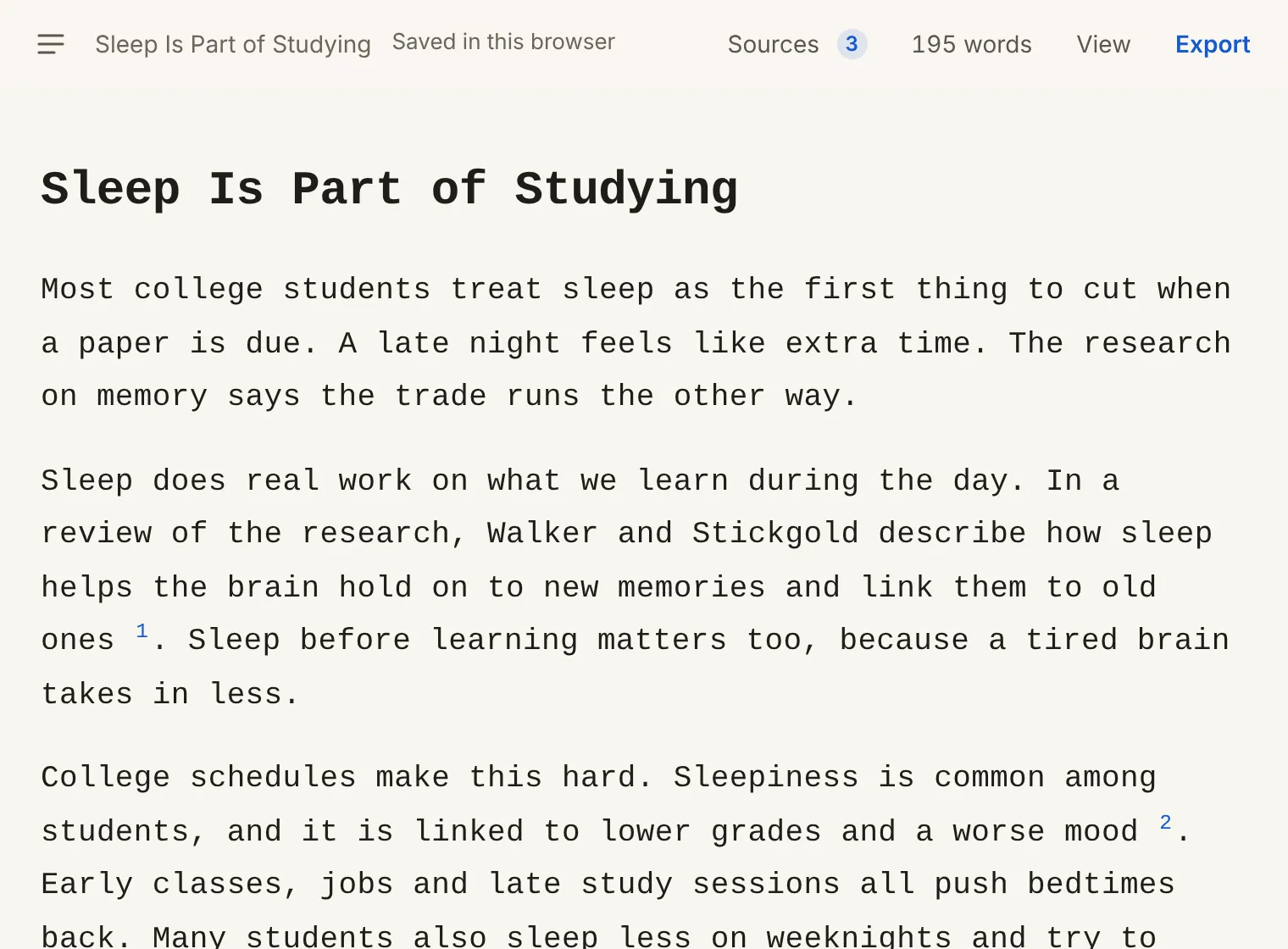

What you get
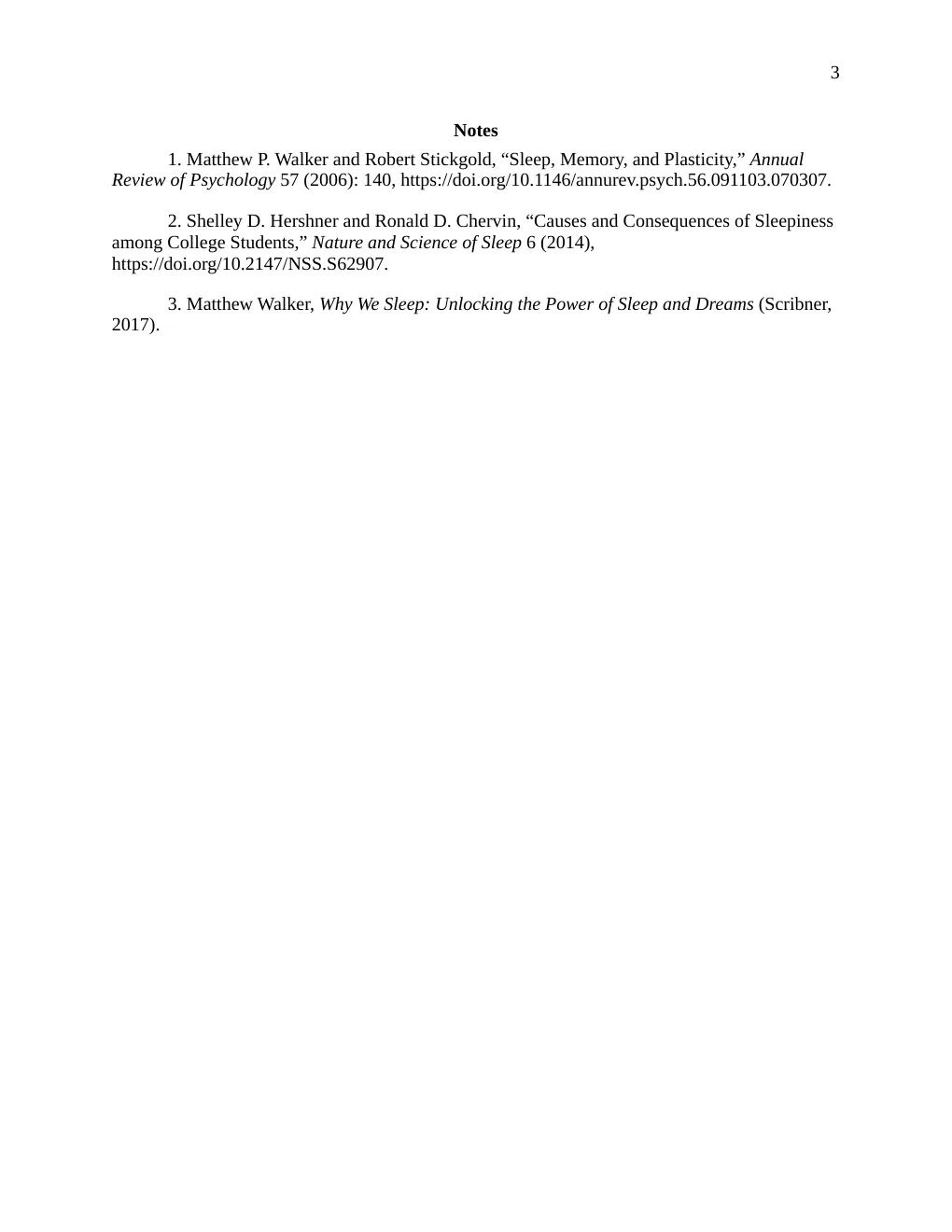
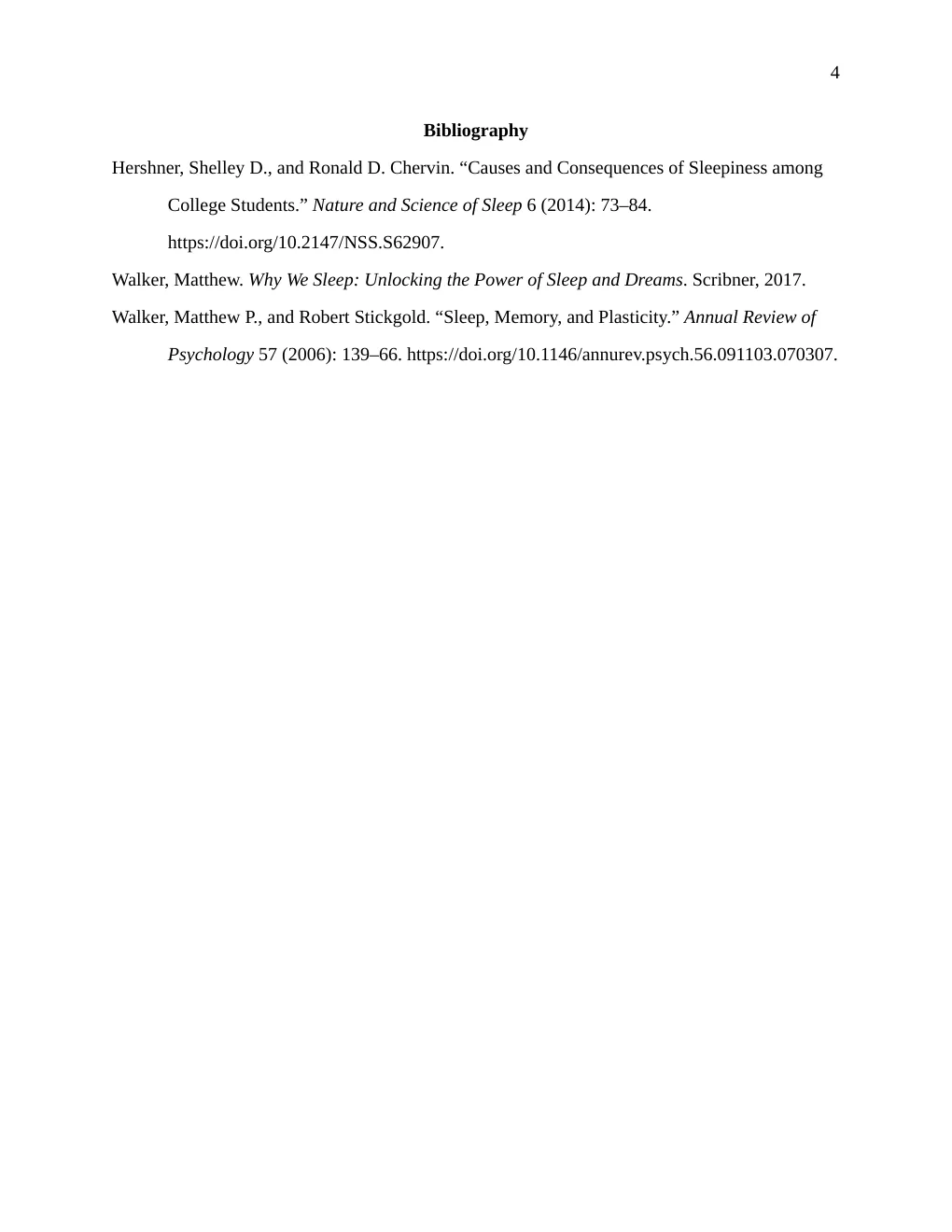
A real PDF exported from Format in Chicago notes and bibliography. In a PDF the notes are listed on a Notes page before the bibliography. In a Word file they sit at the foot of each page as real footnotes.
The mistakes teachers mark down
- Note numbers before the punctuation. They go after the period or comma.
- Numbers that start over. Notes count up through the whole paper.
- A full note every time. After the first one, shorten it.
- Notes written like bibliography entries. Or the other way around. They use different order and punctuation.
- A bibliography without a hanging indent. Or one that is not in alphabetical order.
- Mixing systems. Footnotes and (Author Year) citations in the same paper.
Or let Format do it.
Write the paper, add sources from a link, DOI or ISBN, and press Cite. Format numbers the notes, writes the full note the first time and the short note after that, and builds the title page and bibliography. Word files get real footnotes. Switch to MLA or APA and every citation changes with it. Chicago 18 is part of Pro, $4 a month or $29 a year.
Questions
What is the difference between Chicago and Turabian?
Turabian is the student version of Chicago. The citations are the same. Turabian adds rules for class papers, like the title page, margins and spacing.
Should I use footnotes or endnotes?
Either is correct in Chicago unless your teacher picks one. Footnotes sit at the bottom of each page. Endnotes are collected on a Notes page before the bibliography. Most class papers use footnotes.
Do I need a bibliography if I use footnotes?
Usually, yes. Most teachers expect one. It lists every source in alphabetical order so a reader can find them all in one place.
Should I use ibid. in Chicago style?
The 18th edition prefers a short note, like Walker, Why We Sleep, 115, even for the same source twice in a row. Ibid. is still allowed, so use it if your teacher asks for it.
Is the bibliography single- or double-spaced?
Turabian single-spaces each entry and leaves a blank line between entries. Some teachers want everything double-spaced. Either way, every entry gets a half-inch hanging indent.
What changed in the 18th edition of Chicago?
Book citations no longer need the city of publication. Notes use et al. after the first author when there are three or more. Bibliographies list up to six authors. Short notes are preferred over ibid.