On this page
MLA rules at a glance
These are the settings for a student paper in MLA 9, the current edition of the MLA Handbook. If your teacher gives you different instructions, theirs win.
- Paper
- US Letter, 8.5 by 11 inches.
- Margins
- 1 inch on all four sides.
- Font
- A readable font such as Times New Roman, at 12 point. Italics must look different from regular text.
- Spacing
- Double-spaced everywhere, from the heading block to the last Works Cited entry. No extra space between paragraphs.
- Header
- Your last name and the page number, top right, half an inch from the top of every page.
- Heading block
- Your name, your instructor, the course and the date, on four lines at the top left of page 1.
- Title
- Centered, in title case. Not bold, italic, underlined or in quotation marks.
- Paragraphs
- Indent the first line half an inch. Line up text on the left and leave the right edge ragged.
- Title page
- None, unless your teacher asks for one.
- Works Cited
- On a new page, entries in alphabetical order, each with a half-inch hanging indent.
Set up the page
Set 1-inch margins and double spacing before you type a word. In Word, look for Line and Paragraph Spacing and pick 2.0. Then set the space before and after paragraphs to 0. Word adds a little extra space by default, and teachers notice it.
Use one font from top to bottom. Times New Roman at 12 point is the safe choice. Put one space after a period, not two.
The header and page numbers
Every page gets a header in the top right corner, half an inch from the top: your last name, one space, and the page number. Nothing else. No "p.", no "Page", no comma.
Reyes 3
Use your word processor's header and page number tools, so the number counts up by itself. If your teacher asks you to leave the header off page 1, do that.
The heading block and title
MLA papers do not have a title page. Instead, page 1 starts with four lines at the top left, double-spaced like the rest:
- Your full name
- Your instructor's name
- The course name or number
- The date, written day, month, year: 2 November 2026
On the next line, center your title. Use title case: capitalize the first word, the last word and every main word. Leave short words like a, of, and and in lowercase in the middle. Do not make it bold or bigger, and add no extra blank lines above or below it.
Reyes 1
Dana Reyes
Professor Okafor
ENGL 101
2 November 2026
Sleep Is Part of Studying
Most college students treat sleep as the first thing to cut when a paper is due.
If your title names another work, style that title as you would anywhere: italics for a book or film, "quotation marks" for an article or poem. For a group project, list each writer's name on its own line, then the instructor, course and date.
Paragraphs, headings and block quotes
Indent the first line of every paragraph half an inch. Use the Tab key or the paragraph settings, never the space bar.
Headings
Short essays usually need none. In a longer paper, MLA lets you choose a style as long as you keep it the same everywhere. A common choice is bold, flush left, in title case for main sections, and italics for subsections. No period at the end.
Block quotes
A quote that runs more than four lines of prose, or more than three lines of poetry, becomes a block quote:
- Start it on a new line and indent the whole quote half an inch from the left margin.
- Keep it double-spaced, and leave out the quotation marks.
- For prose, put the citation after the final period. For poetry, keep the poet's line breaks.
Shorter quotes stay in your sentence, inside quotation marks, with the citation before the period: "quoted words" (Hershner and Chervin 75).
In-text citations
An MLA citation is short: the author's last name and the page number, in parentheses, with no comma between them. It points to one entry in your Works Cited. Put it at the end of the sentence, before the period.
- One author(Walker 112)
- Two authors(Walker and Stickgold 140)
- Three or more(Lopez et al. 8)
- Name in your sentenceHershner and Chervin report that sleepiness is common among students (75).
- No author("About Sleep")
- No page numbers(Hershner and Chervin)
When there is no author, use the title, shortened if it is long, styled as it is in Works Cited. When a source has no page numbers, like most web pages, leave the number out. Do not write "p." or "pg."
The Works Cited page
- Start it on a new page at the end, with the same header.
- Center the words Works Cited at the top. Plain text: not bold, not underlined. Use Work Cited if you have only one source.
- Double-space it, with no extra lines between entries.
- List entries in alphabetical order by the first word, usually the author's last name. Skip A, An and The when sorting.
- Give every entry a half-inch hanging indent: the first line starts at the margin and the rest are indented.
- The first author goes last name first. With two authors, write the second one first name first. With three or more, list the first author and add "et al."
- Write a DOI as a link, starting with https://doi.org/. For a web address, you can leave off the https://.
Here are a book, a journal article with a DOI, and a web page with no author, in the order they would appear:
Works Cited
Web page, no author
"About Sleep." Centers for Disease Control and Prevention, 15 May 2024, www.cdc.gov/sleep/about/index.html.
Journal article with a DOI
Hershner, Shelley D., and Ronald D. Chervin. "Causes and Consequences of Sleepiness among College Students." Nature and Science of Sleep, vol. 6, 2014, pp. 73-84, https://doi.org/10.2147/NSS.S62907.
Book
Walker, Matthew. Why We Sleep: Unlocking the Power of Sleep and Dreams. Scribner, 2017.
The web page starts with its title because the author and the website are the same organization. MLA skips the author in that case, and the publisher too.
An MLA paper, start to finish
What you type
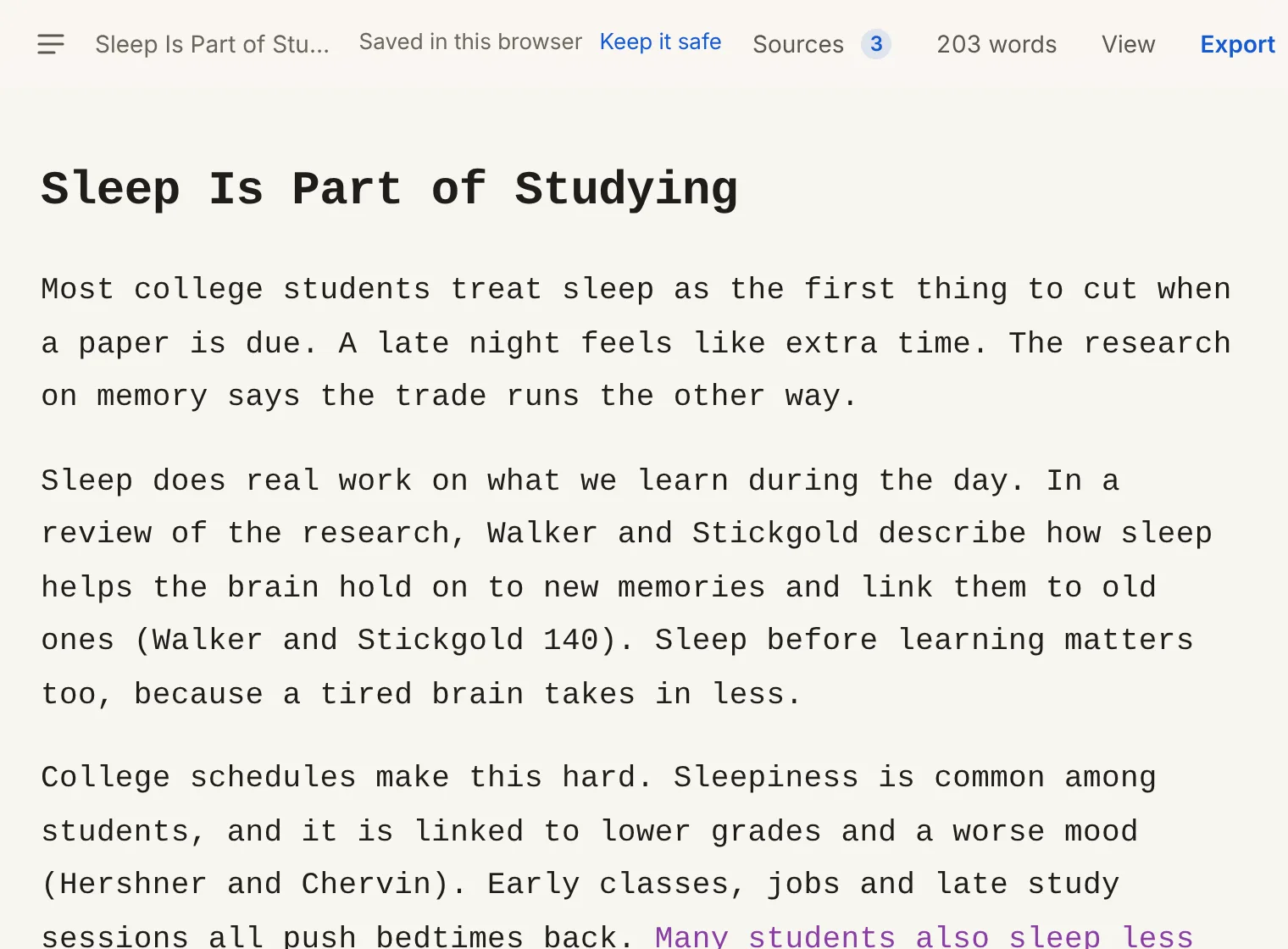
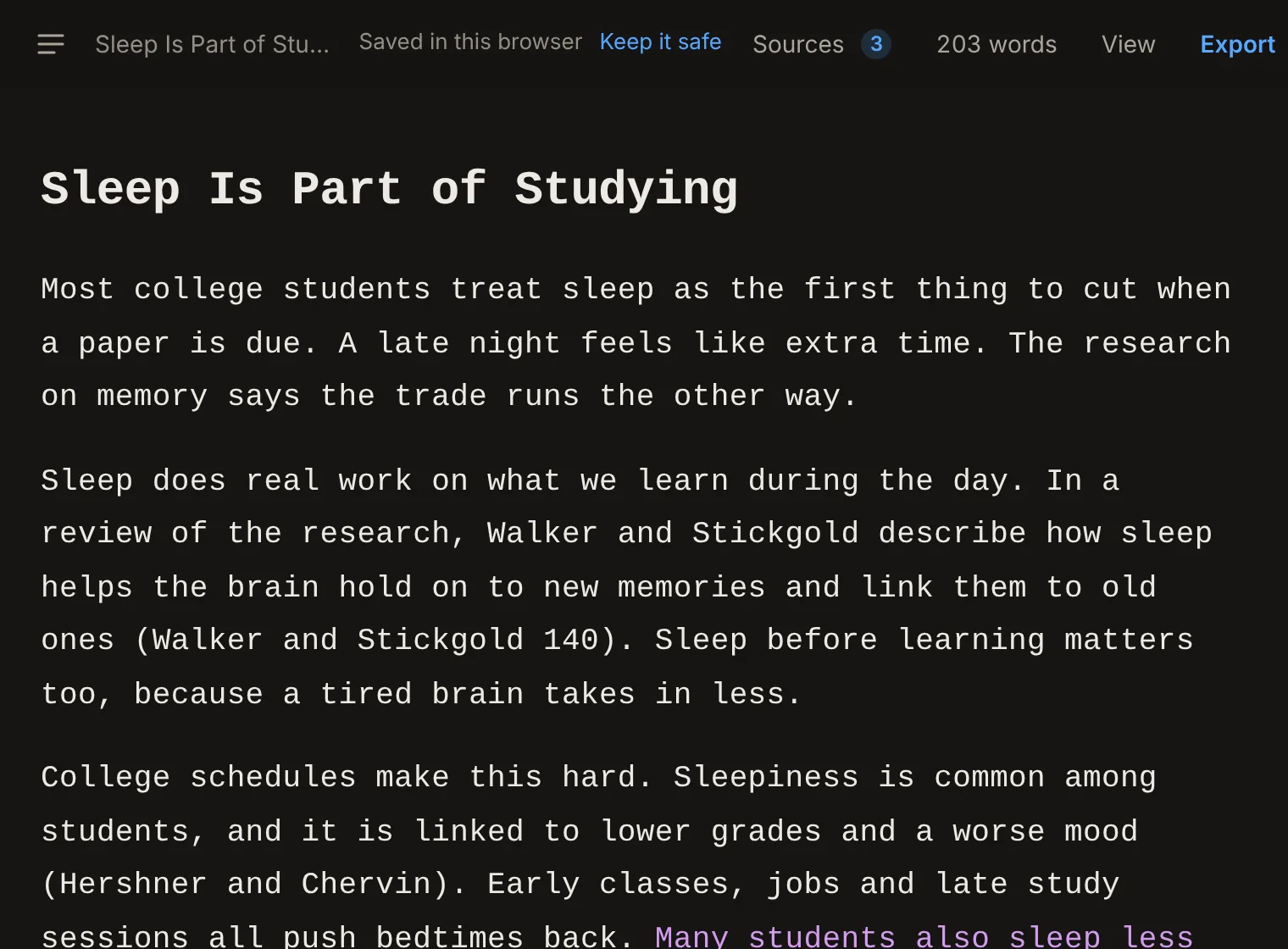
What you get
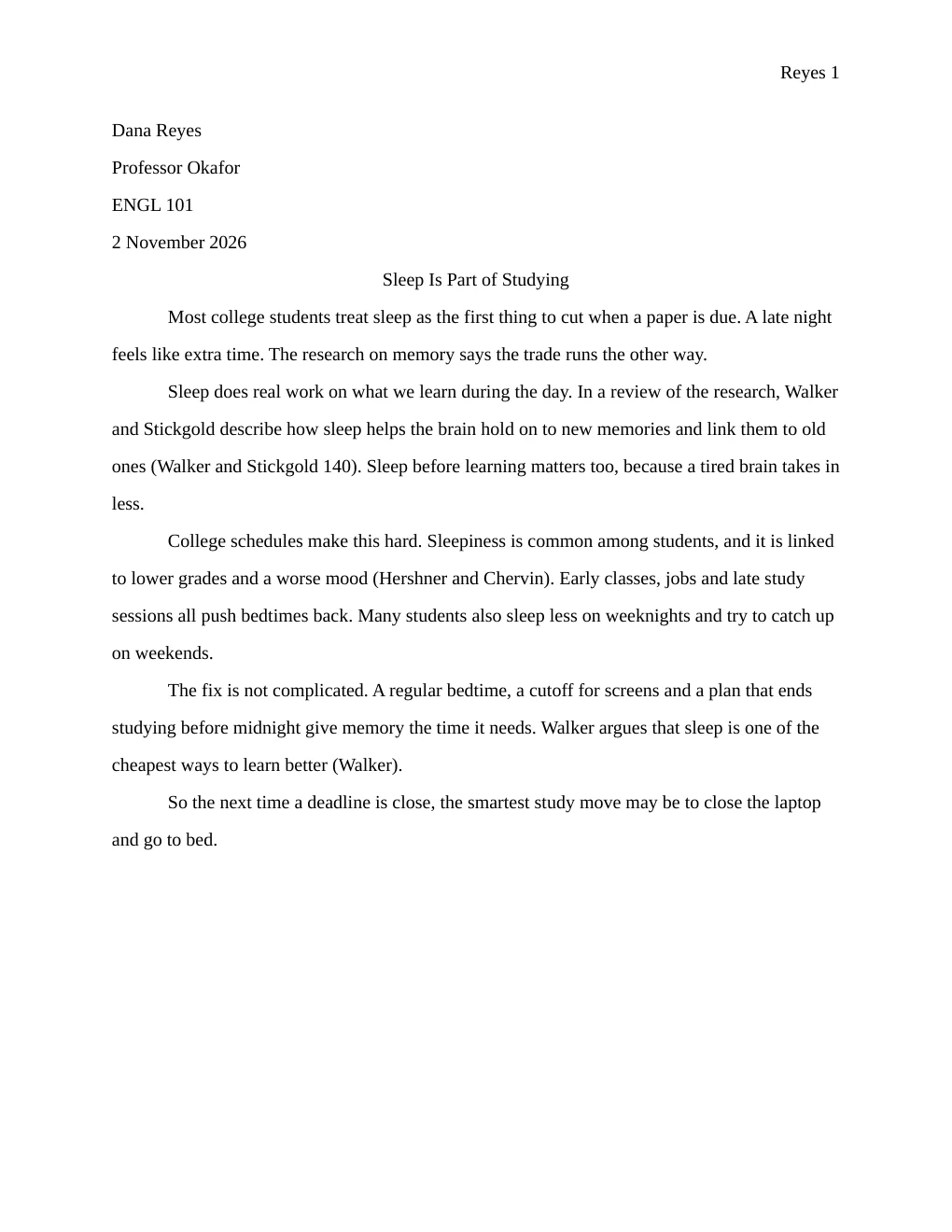
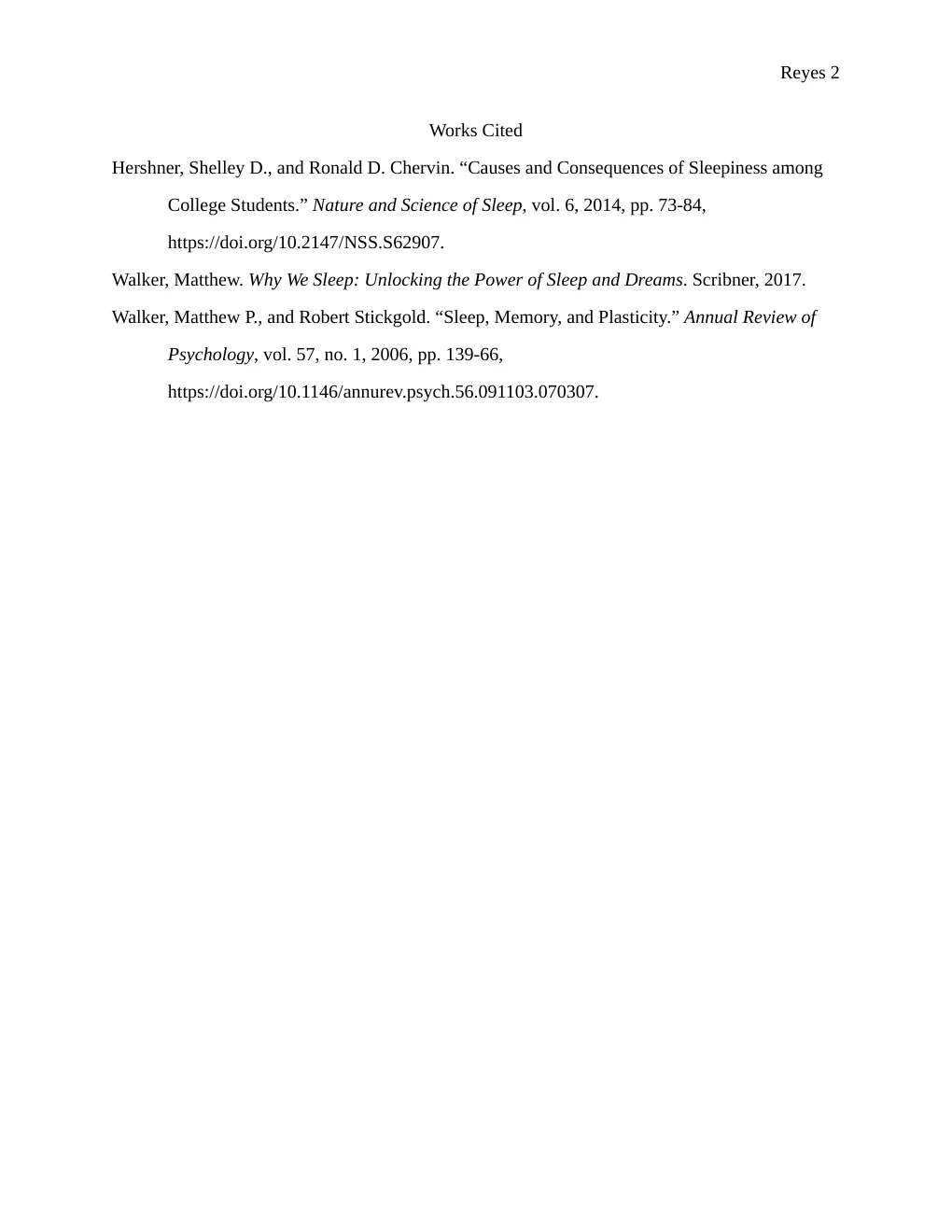
A real PDF exported from Format in MLA 9. The writer typed the title and the paragraphs and added three sources. Format set everything else.
The mistakes teachers mark down
- A styled title. Bold, underlined, bigger or in quotation marks. Keep it plain and centered.
- The wrong header. "Page 1", your full name, or no header at all. It is your last name and the number.
- Extra space. Blank lines between paragraphs or around the title, often from Word's default spacing. Set before and after to 0.
- No hanging indent. Or one faked with tabs and spaces that breaks when a line wraps.
- Works Cited out of order. Not alphabetical, or not on its own page.
- The period in the wrong place. It goes after the citation: memories (Walker and Stickgold 140).
- Citations that do not match. Every citation needs a Works Cited entry, and every entry needs to be cited.
Or let Format do it.
Write on a page that already looks like an MLA paper. Format sets the margins, double spacing, header and heading block. Paste a link, DOI or ISBN to add a source, press Cite, and the citation goes where you are typing. When you export to Word or PDF, the Works Cited page is built for you, in order, with hanging indents. MLA is free.
Questions
Does an MLA paper need a title page?
No. MLA uses a heading block at the top left of page 1 instead: your name, your instructor, the course and the date. Add a title page only if your teacher asks for one, and then follow their layout.
What font and size should I use for MLA?
Any readable font where italics look different from regular text. Times New Roman at 12 point is the safe choice, and it is what most teachers expect.
What goes in the MLA header?
Your last name, one space, and the page number, in the top right corner half an inch from the top. It goes on every page, including Works Cited.
Is the Works Cited page double-spaced?
Yes. Double-space it like the rest of the paper, with no extra blank lines between entries. Each entry gets a half-inch hanging indent.
How do I cite a source with no author or no page numbers?
With no author, use the title in the citation, shortened if it is long: ("About Sleep"). With no page numbers, leave the number out: (Hershner and Chervin).
Do I need URLs and access dates in Works Cited?
Include a URL for web sources, and a DOI for articles that have one, written as https://doi.org/ and the number. An access date is optional. Add one when the page shows no date of its own.