On this page
Updated
The sample paper
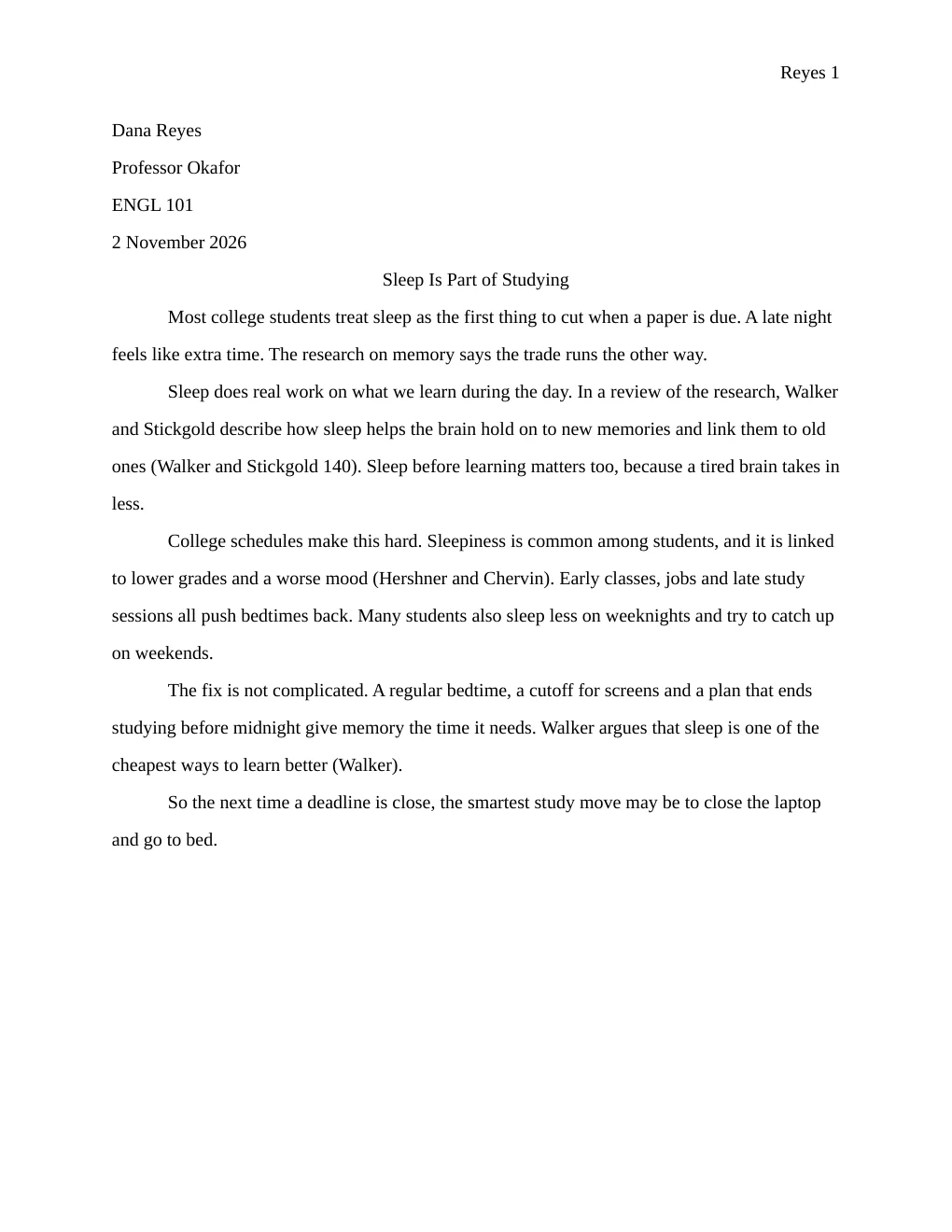
Set in Times New Roman 12, double-spaced, with one-inch margins. The page labels mark where a new page starts when the paper is printed.
Page 1
Reyes 1
Dana Reyes
Professor Okafor
ENGL 101
2 November 2026
The Sleep Students Skip
Most college students know the feeling of a paper due at nine in the morning and a draft that is not finished at midnight. Sleep is usually the first thing to go. It feels like a trade with no cost: a few hours of rest for a few hours of work. The research on college students suggests the trade costs more than it saves, and that protecting sleep is part of doing the work well.
The problem is common. In their review of research on college students, Shelley Hershner and Ronald Chervin report that “50% report daytime sleepiness and 70% attain insufficient sleep” (73). That is not a few students in a bad week; it is most of a campus. Federal health guidance lists seven or more hours a night as what adults need (“About Sleep”), and many students fall short of it most nights.
The cost shows up in grades. Hershner and Chervin connect insufficient sleep and sleepiness with “lower grade point averages, increased risk of academic failure, compromised learning” (73). A student who stays up to finish one assignment may lose more in the next week of classes than the extra hours gained.
Sleep also does work of its own. One sleep scientist’s book argues that sleep supports learning and memory rather than interrupting them (Walker). If that is right, the night before an exam is better spent partly asleep than entirely awake.
None of this means a student can always get eight hours. Jobs, families and deadlines are real. But a schedule that treats sleep as fixed, and plans the work around it, is more likely to produce the grades the late nights were meant to protect.
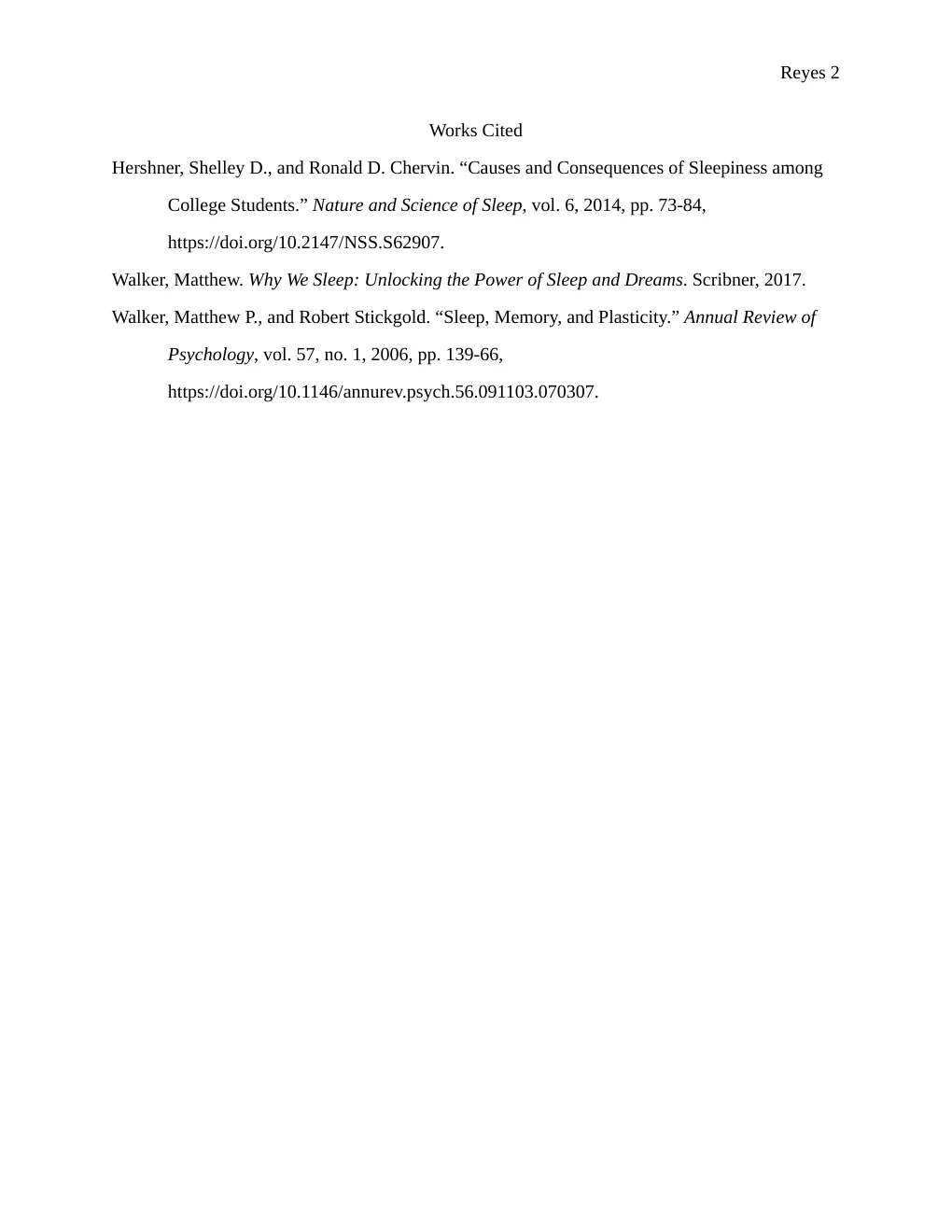
Page 3: Works Cited, on a new page
Reyes 3
Works Cited
“About Sleep.” Centers for Disease Control and Prevention, 15 May 2024, www.cdc.gov/sleep/about/index.html.
Hershner, Shelley D., and Ronald D. Chervin. “Causes and Consequences of Sleepiness among College Students.” Nature and Science of Sleep, vol. 6, 2014, pp. 73-84, https://doi.org/10.2147/NSS.S62907.
Walker, Matthew. Why We Sleep: Unlocking the Power of Sleep and Dreams. Scribner, 2017.
Each rule, from top to bottom
- The header. Your last name and the page number, top right, half an inch from the top, on every page including Works Cited. See MLA header.
- The heading. Four lines at the top left of page 1: your name, the instructor, the course, the date (day month year). No title page. See MLA heading.
- The title. Centered, in title case, plain text: no bold, italics, quotation marks or larger size.
- The text. Double-spaced throughout, with no extra space between paragraphs. Each paragraph starts with a half-inch indent. Margins are one inch on every side.
- A quotation with a page. The authors are named in the sentence, so the parentheses after the quotation hold only the page: (73). When the sentence does not name them, both go in: (Hershner and Chervin 73).
- A source with no author or page. When an organization both writes and publishes a page, MLA starts the entry with the title, so the citation is the title in quotation marks: (“About Sleep”). A web page has no page numbers, so there is none.
- A whole book. A claim about a book’s argument as a whole needs no page: (Walker).
- Works Cited. On a new page, with the header continuing. The title Works Cited is centered and plain. Entries are in alphabetical order, double-spaced, with a half-inch hanging indent. See Works Cited.
The same rules in a real PDF
These pages were exported from Format in MLA 9. The writer typed the title and the paragraphs and added three sources; Format set the header, heading, spacing and Works Cited.
Make your own
To write one by hand, follow the setup for your app: MLA in Google Docs or MLA in Word. To skip the setup, write in Format: the page starts in MLA, Cite puts the citation at your cursor, and Export builds the Works Cited page.
Every MLA rule, with more examples, is in MLA format. The APA version of this paper is the APA sample paper.
Questions
Does an MLA paper have a title page?
No. Page 1 starts with the four-line heading and the title. Add a title page only if your instructor asks for one.
Is the Works Cited page double-spaced?
Yes, like the rest of the paper, with a half-inch hanging indent on each entry.
What font does MLA require?
A readable font, such as Times New Roman, at a standard size. Times New Roman 12 is the safe choice, and what most instructors expect.